
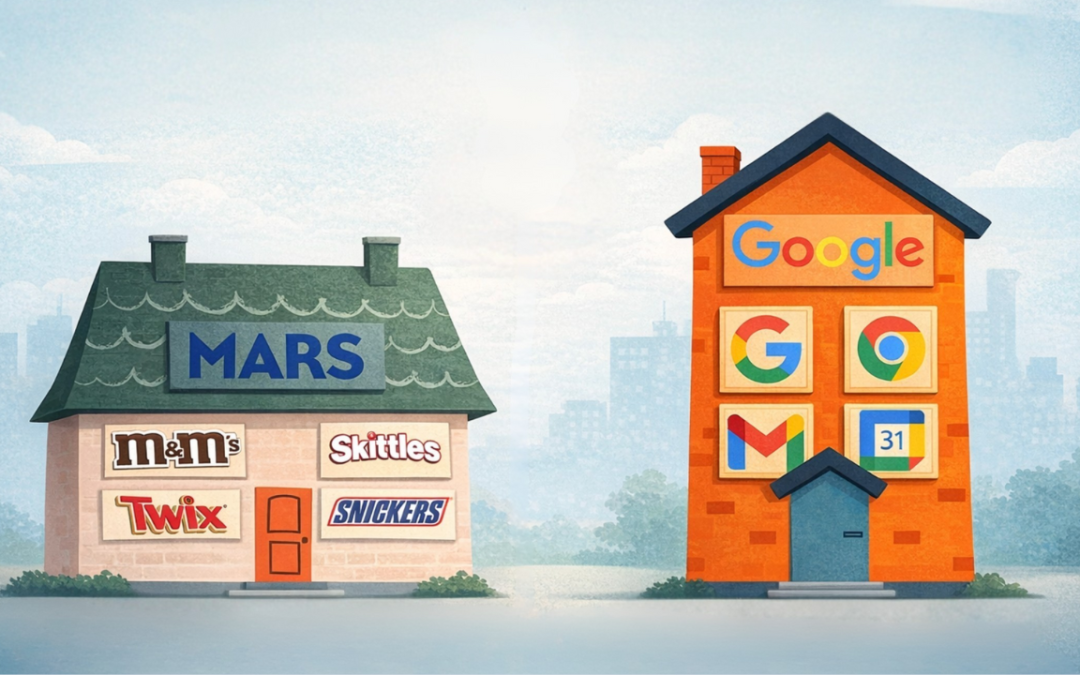
Brand architecture is the strategic framework that defines how your company’s portfolio of products, services, and sub-brands relate to one another and the parent brand. Choosing the right structure is critical: it influences how customers perceive your business, how you allocate marketing resources, and how your brand can scale over time.
Two of the most common approaches are the House of Brands and the Branded House. Understanding the differences between them helps you make informed decisions about growth, messaging, and positioning.
House of Brands: Individuality at Its Core
A house of brands treats each product or service as its own unique brand, independent of the parent company. Classic examples include Procter & Gamble with brands like Tide, Pampers, and Gillette, or Unilever with Dove, Axe, and Lipton.
Advantages:
- Targeted Messaging: Each brand can be positioned for a distinct audience without being constrained by the parent brand.
- Risk Containment: Issues with one brand do not automatically tarnish the reputation of others.
- Flexibility: The company can launch new brands with unique identities and marketing strategies.
Challenges:
- Higher Costs: Maintaining separate brand identities requires more marketing resources.
- Brand Equity Limitations: The parent company may not benefit from consumer loyalty toward individual brands.
- Complexity: Coordinating multiple brands can become operationally challenging.Branded House: One Identity, Many Extensions
Branded House: One Identity, Many Extensions
In contrast, a branded house emphasizes the parent brand across all products and services. Google exemplifies this approach with Google Maps, Google Drive, and Google Ads — all under the same recognizable brand umbrella.
Advantages:
- Brand Recognition: Every new product automatically benefits from the parent brand’s reputation.
- Marketing Efficiency: Cross-promotion is easier and more cost-effective.
- Unified Messaging: Consistent voice and identity across offerings.
Challenges:
- Reputation Risk: A misstep in one product can affect the entire brand.
- Less Flexibility: Products must align with the parent brand, limiting creative positioning.
- Audience Targeting: Niche products may find it harder to appeal to specific segments.
Factors to Consider When Choosing a Model
- Business Goals – Are you aiming for rapid expansion across diverse markets, or building deep recognition under one name?
- Audience Diversity – If your products serve completely different audiences, a house of brands may work better.
- Marketing Resources – Do you have the budget and team to maintain multiple brand identities?
- Long-Term Vision – Consider how your portfolio might evolve in 5–10 years.
Case Examples
- House of Brands: Procter & Gamble leverages multiple strong brands to dominate different market niches without overlap.
- Branded House: Google uses its parent brand to create instant recognition and trust across its services.
Final Thoughts
Brand architecture is more than a design decision — it’s a strategic choice that shapes how your company communicates, scales, and grows. Companies that carefully consider their structure can maximize brand equity, streamline marketing, and deliver clarity to customers. Whether you choose a house of brands or a branded house, the key is aligning your brand strategy with your business goals, audience needs, and long-term vision.